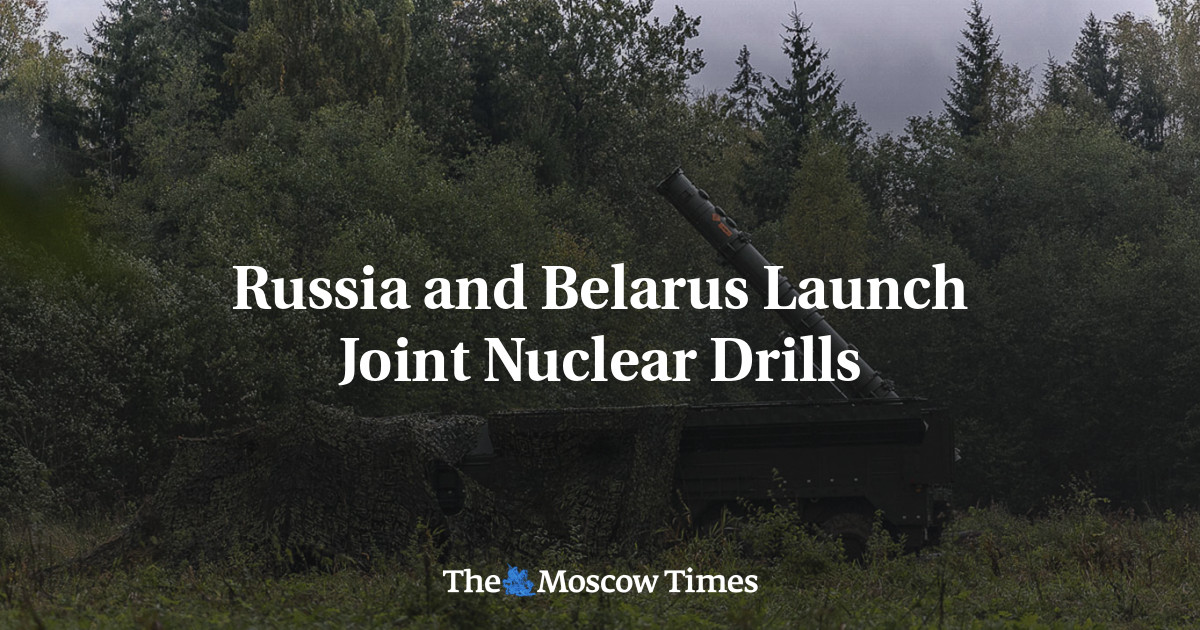
Belarus announced on Monday that it is conducting nuclear weapons training exercises in coordination with Russia. The Belarusian Defense Ministry stated that the drills aim to enhance the armed forces' readiness to use modern weapons systems.
The exercises come at a time when regional tensions remain elevated. Since Russia's invasion of Ukraine in February 2022, the security situation in Eastern Europe has deteriorated dramatically. Belarus, under President Alexander Lukashenko's leadership, has positioned itself as a close ally of Russia and allowed Russian forces to use its territory as a staging ground for military operations.
Russia has deployed tactical nuclear weapons in Belarus as part of a bilateral agreement between Moscow and Minsk. This deployment was justified as a response to Western military aid to Ukraine and NATO expansion. The current exercises focus on training for the combat use of these weapons systems, according to officials.
Both Belarusian and Russian representatives emphasized that the exercises are not directed against third countries and do not pose a threat to regional security. The Belarusian Defense Ministry explicitly stated that the training measures are defensive in nature and serve to maintain military readiness.
The announcement of nuclear weapons drills occurs within a complex geopolitical environment. The international community monitors such developments closely, as they could be interpreted as potential escalation signals. At the same time, military exercises, including those involving nuclear weapons, are a regular component of defense planning for many nations.
Experts note that such exercises typically serve to maintain operational readiness and test command structures. They are part of regular military training and weapons systems maintenance. Conducting such maneuvers is not internationally unusual, though the current context generates particular attention.
Military cooperation between Belarus and Russia has intensified in recent years. Both countries are members of the Collective Security Treaty Organization (CSTO) and regularly conduct joint military exercises. The integration of their defense structures is part of a broader strategic partnership.
The international reaction to the announcement of the exercises remains to be seen. Western governments have previously expressed concerns about the deployment of Russian nuclear weapons in Belarus, describing the development as destabilizing to European security architecture.
Specific details about the scope, duration, and particular objectives of the current exercises have not been fully disclosed by the involved authorities. It remains unclear whether the maneuvers are part of a larger series of military exercises or conceived as a standalone training measure. Further developments in the situation will be closely monitored by international observers and security experts.
The timing of these nuclear drills adds another layer of complexity to an already tense regional security environment. While both countries maintain the exercises are routine and defensive, the broader context of the ongoing conflict in Ukraine and deteriorating East-West relations ensures continued scrutiny of such military activities.
Fast take
Belarus announced on Monday that it is conducting nuclear weapons training exercises in coordination with Russia.
NOFRAME signal
Medium divergence · 4 Sources · 4 Regions
What remains open
Coverage is not fully split, but it is not identical either. That makes the comparison useful: the fact base shows the common core, while the perspectives show where political, regional, or institutional priorities change the emphasis.
Dossier compass
Which media spaces carry the story and how broad the source base is.
Source mix
Underlit angles
- Specific duration or details of exercises
- International reactions
- Political context or classification
Open originals
Go straight to the linked articles. NOFRAME does not replace those sources.
Why it matters
Coverage is not fully split, but it is not identical either. That makes the comparison useful: the fact base shows the common core, while the perspectives show where political, regional, or institutional priorities change the emphasis.
Timeline
Straits Times · May 18, 2026 at 07:48 AM
Belarus holds nuclear weapons drills, defence ministry says
The Hindu · May 18, 2026 at 08:54 AM
Belarus holds nuclear weapons drills, Defence Ministry says
Anadolu EN · May 18, 2026 at 10:17 AM
Belarus, Russia hold drills on combat use of nuclear weapons
Moscow Times · May 18, 2026 at 11:00 AM
Russia and Belarus Launch Joint Nuclear Drills