Russia and Belarus conducted joint nuclear forces exercises on May 21, with Presidents Vladimir Putin and Alexander Lukashenko observing the drills via video link. The three-day military exercise represents a significant demonstration of nuclear cooperation between the two countries within their Union State framework.
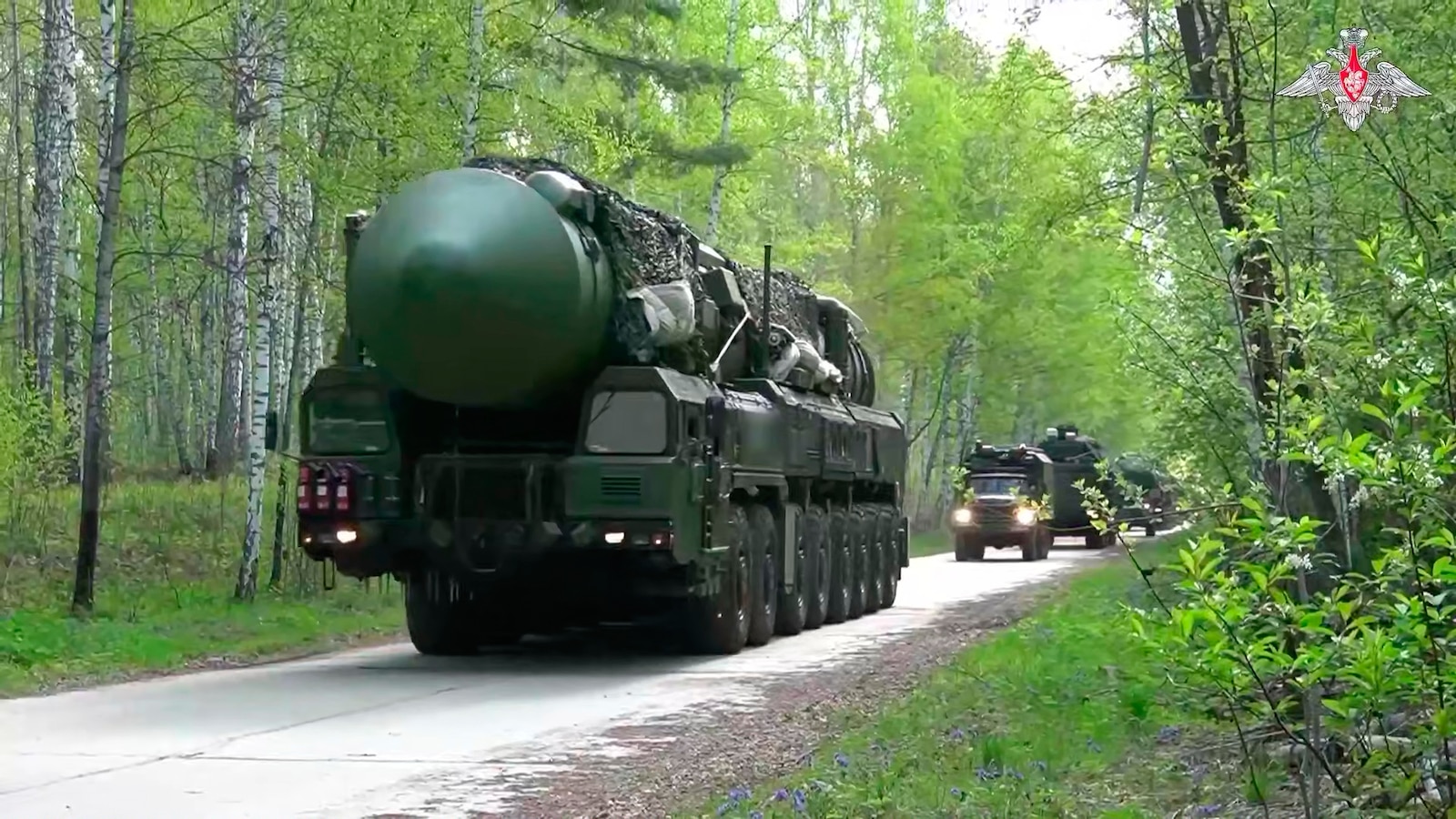
According to Russian sources, the exercise involved the delivery of nuclear warheads to sites in Belarus, where Belarusian military personnel practiced handling special munitions for Iskander-M short-range missile systems. The training included loading launch tubes with warheads and stealthily advancing to designated areas in preparation for potential launches.
The scale of the exercise was substantial, involving over 64,000 military personnel and more than 7,800 pieces of equipment, including over 200 missile launchers, more than 140 aircraft, 73 surface ships, and 13 submarines. The maneuvers spanned land, sea, and air operations, with intercontinental ballistic missiles transported over forest roads, submarines departing from Arctic and Pacific ports, and flight crews scrambling to warplanes.
During the exercise, Putin praised Belarusian allies for their nuclear expertise and highlighted the well-coordinated work of Belarusian military personnel. Lukashenko emphasized that countries possessing nuclear weapons must understand how to use them effectively. Putin characterized the use of nuclear weapons as an 'exceptional measure' and 'last resort' for ensuring national security.
Russian officials described the exercise as a planned training event within the Union State framework between Russia and Belarus. The maneuvers were presented as part of regular military cooperation between the two countries, which have maintained close defense and other ties for years.
International reaction to the exercises was critical. Western sources characterized the drills as provocative, with European officials condemning what they termed Putin's 'irresponsible rhetoric.' The exercises took place against the backdrop of ongoing tensions between Russia and Western countries, particularly in the context of the conflict in Ukraine.
Ukrainian officials assessed the situation from a security perspective, concluding that Russia currently lacks sufficient forces for provocations from Belarusian territory. A Ukrainian representative stated that due to the situation on the front lines, Russians do not have the capability to assemble a grouping of forces for provocations from Belarus.
The exercises underscore the continued military partnership between Moscow and Minsk, with Belarus serving as a crucial strategic ally for Russia. The country previously served as a launching point for Russia's 2022 invasion of Ukraine, highlighting the geopolitical significance of Belarusian-Russian military cooperation.
The demonstration of nuclear capabilities by both countries occurs at a time of heightened international tensions and is interpreted by observers as a signal to Western nations. The exercises showcase the operational readiness of both countries' nuclear forces and their ability to conduct coordinated nuclear operations.
The joint drills also reflect the deepening military integration between Russia and Belarus, with Belarusian forces receiving training on advanced Russian weapons systems. This cooperation extends beyond conventional forces to include nuclear weapons handling and deployment procedures, marking a significant development in regional security dynamics.
The timing and scope of these exercises have drawn attention from international security analysts, who view them as part of broader strategic messaging during a period of global uncertainty. The exercises demonstrate both countries' commitment to maintaining nuclear deterrent capabilities while showcasing their operational coordination in potential crisis scenarios.
Fast take
Russia and Belarus conducted joint nuclear forces exercises on May 21, with Presidents Vladimir Putin and Alexander Lukashenko observing the drills via video link.
NOFRAME signal
Medium divergence · 8 Sources · 3 Regions
What remains open
Coverage is not fully split, but it is not identical either. That makes the comparison useful: the fact base shows the common core, while the perspectives show where political, regional, or institutional priorities change the emphasis.
Dossier compass
Which media spaces carry the story and how broad the source base is.
Source mix
Underlit angles
- Western criticism and condemnation of exercises
- Characterization as provocative measure
- Technical details of exercise procedures
Open originals
Go straight to the linked articles. NOFRAME does not replace those sources.
Why it matters
Coverage is not fully split, but it is not identical either. That makes the comparison useful: the fact base shows the common core, while the perspectives show where political, regional, or institutional priorities change the emphasis.
Timeline
Anadolu EN · May 21, 2026 at 03:17 PM
Putin and Lukashenko oversee joint Russian-Belarusian nuclear exercise
The Independent · May 21, 2026 at 03:23 PM
Putin says using nuclear weapons would be ‘last resort’ after massive joint drills with Belarus
TASS · May 21, 2026 at 03:26 PM
IN BRIEF: Putin, Lukashenko observe joint Russia-Belarus drills via video link
Al Jazeera · May 21, 2026 at 03:32 PM
Russia rehearses ‘use of nuclear forces’ in drills with Belarus