Russia held a parliamentary election from Friday to Sunday, the first vote for the State Duma since the country launched its full-scale invasion of Ukraine in February 2022. Around 111 million people were eligible to cast ballots. According to Russia's Central Election Commission, the ruling United Russia party was leading with approximately 57 percent of the vote after a majority of precincts had been counted. The Communist Party followed with roughly 14 percent, the Liberal Democratic Party with about 9 percent, and the New People party with around 8 percent. The A Just Russia party also cleared the required 5 percent threshold to win seats. Multiple parties competed, but reports consistently note the absence of any serious opposition to President Vladimir Putin's policies on the ballot.
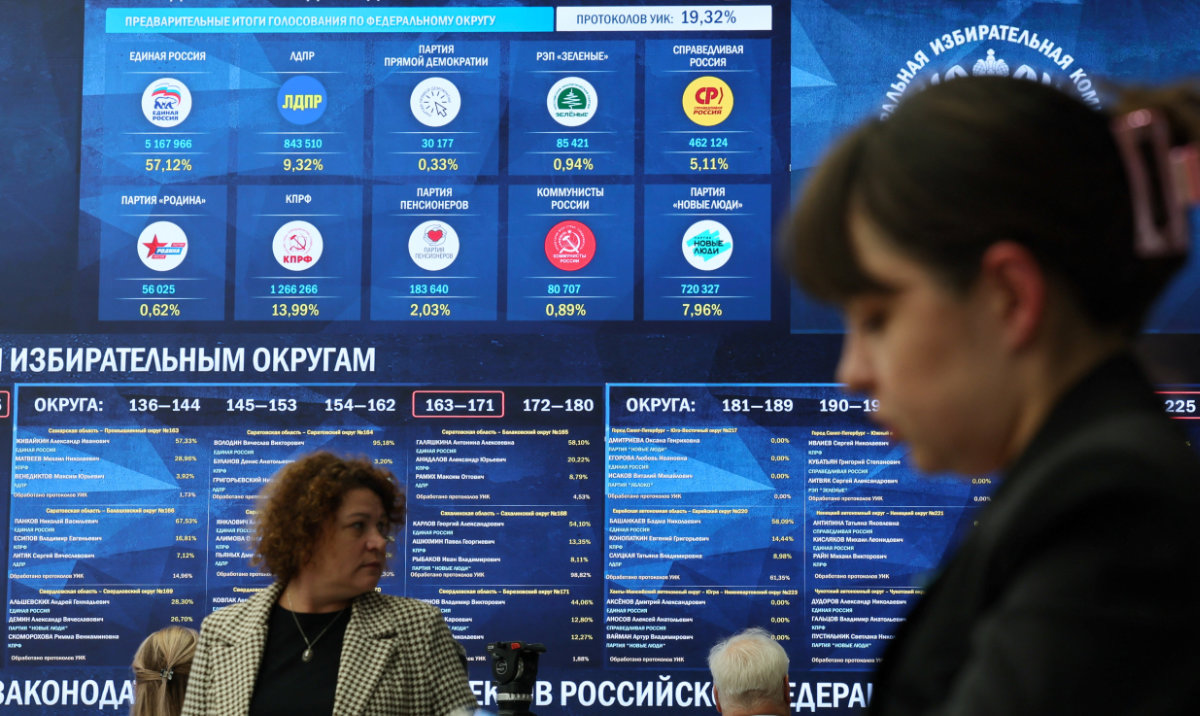
Notably, this was the first Duma election in which residents of four Ukrainian regions annexed by Russia after the war began were able to vote, alongside residents of Crimea, which Russia annexed in 2014. Ukraine and Western governments consider these annexations illegal under international law, as the territories are internationally recognized as part of Ukraine. Russia does not fully control some of these regions, adding further controversy to the voting process there.
The election took place against a tense security backdrop. Reports indicate that a large-scale Ukrainian drone attack targeted Moscow around the time of the vote. Specific details on damage or targets were not fully specified in available reporting, but the timing was widely noted by international outlets as significant context.
President Putin had earlier framed the parliamentary election as a kind of barometer of public support for his war policy in Ukraine. Western observers describe the vote as tightly controlled, pointing out that no genuine political alternative to the ruling party was realistically able to compete. Independent international election observation was reportedly severely limited or largely absent, complicating any independent assessment of the vote's fairness.
Russian state media, including the news agency TASS, reported the vote count in a straightforward manner, presenting the results as an orderly democratic process in which several parties secured parliamentary representation. The independent, exiled Russian-language outlet Meduza confirmed the same key figures from the election commission but placed the results within the broader, well-documented context of United Russia's structural dominance over the political system.
International coverage diverges notably in tone. Media outlets in Arab and Asian countries largely reported the expected United Russia victory in a descriptive manner, while also noting the limited political competition. A commentary published by Al Jazeera argued that Russian elections serve as more than mere political theater, functioning instead as a mechanism through which the Kremlin gathers feedback and reinforces legitimacy, even though the outcome is largely predetermined.
Several questions remain open based on current reporting, including how reliable turnout figures are in the annexed territories and how independent observers will ultimately assess the fairness of the overall process once more detailed reports emerge. The precise impact of the reported drone attack on the conduct of the election has also not been fully clarified.
With United Russia on track for a decisive win, the ruling party's control over the State Duma appears set to be reinforced for the coming legislative term. Observers expect this to give the Kremlin a broad parliamentary foundation for its wartime and domestic policies, even as international criticism regarding the legitimacy of the process continues.
Fast take
Russia held a parliamentary election from Friday to Sunday, the first vote for the State Duma since the country launched its full-scale invasion of Ukraine in February 2022.
NOFRAME signal
Stable coverage · 10 Sources · 4 Regions
What remains open
The source picture is relatively consistent. That still makes the details worth reading: small differences in wording, omissions, and source selection can reveal what each region treats as important.
Dossier compass
Which media spaces carry the story and how broad the source base is.
Source mix
Underlit angles
- Details of the Moscow drone attack
- Precise seat distribution among smaller parties
- Detailed results of individual smaller parties
Open originals
Go straight to the linked articles. NOFRAME does not replace those sources.
Why it matters
The source picture is relatively consistent. That still makes the details worth reading: small differences in wording, omissions, and source selection can reveal what each region treats as important.
Timeline
Jakarta Post · September 21, 2026 at 03:00 AM
Russia's ruling party on track to win wartime election after drones strike Mosco...
TRT World · September 21, 2026 at 03:01 AM
United Russia dominates wartime parliamentary election in early returns
TASS · September 21, 2026 at 03:39 AM
United Russia ahead in Duma election with 71.17% of ballots processed
Japan Times · September 21, 2026 at 04:49 AM
Russia’s ruling party set for big win in parliamentary elections