US President Donald Trump has signed a security agreement with Denmark and the autonomous Danish territory of Greenland on the sidelines of the 81st United Nations General Assembly in New York. The signing took place on Tuesday, September 22, 2026, in the presence of Danish Prime Minister Mette Frederiksen and Greenland's Premier Jens-Frederik Nielsen. The three leaders subsequently appeared at a press conference on the roof of the Danish UN mission. The deal is intended to reshape security cooperation between the three parties in the Arctic and grants the United States a significantly expanded military presence on the island.
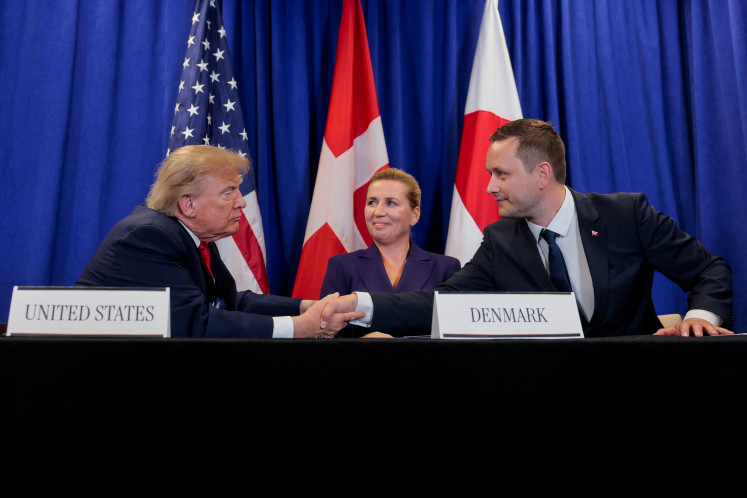
According to multiple international outlets, Greenland will remain under Danish sovereignty, but the United States gains extensive rights to use the island for military purposes. Several reports indicate that at least two new US military bases are planned for Greenland. The agreement reportedly also establishes an accelerated procedure for approving US requests to build unmanned military installations on the island. Additionally, the pact is said to include support for expanding NATO activities in the Arctic region.
Trump himself described the agreement as "tremendous" during the signing ceremony, calling it the start of a "long-term, fantastic relationship" between the countries involved. According to the Russian news agency TASS, the president further stated that the United States would gain "permanent control over security and all other needs" on Greenlandic territory. This characterization was picked up by several outlets, though it remains unclear how far such control extends in legal and practical terms.
At the same time, other reports, including from NDTV, note that the agreement's text explicitly recognizes Greenland's right to self-determination. Under the accord, the United States is reportedly obligated to act in ways that respect Greenlandic society and the Greenlandic way of life. This clause is being interpreted as a concession to Greenland and Denmark, following earlier remarks by Trump about a potential acquisition of the island that had caused considerable friction internationally.
The signing marks a provisional resolution to a dispute that has unfolded over several years. Trump first publicly expressed interest in purchasing Greenland in 2019, during his first term, an idea rejected outright by both Denmark and Greenland at the time. After returning to office, Trump repeatedly emphasized the island's strategic importance and, at times, used pointed rhetoric to press for closer ties between Greenland and the United States. A timeline compiled by NDTV traces this evolving interest back to 2019.
US Senator Jeanne Shaheen, according to TASS, criticized Trump's threats and what she described as "bullying" rhetoric during the negotiations, saying they had come at a cost to trust in the United States. This assessment suggests the path to the agreement was not without tension. The Independent likewise reported that residents of Greenland have warned it will take years for the relationship with the US to fully recover, indicating that support for the deal is not uniform among the island's population.
International coverage of the agreement diverges somewhat in emphasis. Western and Asian outlets have largely framed the deal as a pragmatic step toward easing months of diplomatic tension, while Russian sources such as TASS place greater emphasis on the aspects concerning military control and the expansion of NATO activity in the Arctic. Reports also differ on whether the arrangement should be characterized primarily as cooperative partnership or as an effective extension of American influence over the island.
Several questions remain unresolved. It is not yet clear exactly how the accelerated approval procedures for new military installations will function in practice, what scale the two planned bases will ultimately take, or how Greenlandic public input will be incorporated into future decisions. The broader implications for relations between Washington and the European Union, as well as for the overall security balance in the Arctic, are also difficult to assess at this stage. Notably, the same UN General Assembly sidelines also saw a separate agreement between the United States and Italy on critical minerals, underscoring the high level of diplomatic activity surrounding the assembly.
Fast take
US President Donald Trump has signed a security agreement with Denmark and the autonomous Danish territory of Greenland on the sidelines of the 81st United Nations General Assembly in New York.
NOFRAME signal
Stable coverage · 11 Sources · 5 Regions
What remains open
The source picture is relatively consistent. That still makes the details worth reading: small differences in wording, omissions, and source selection can reveal what each region treats as important.
Dossier compass
Which media spaces carry the story and how broad the source base is.
Source mix
Underlit angles
- No notable omissions in the current source comparison.
Open originals
Go straight to the linked articles. NOFRAME does not replace those sources.
Why it matters
The source picture is relatively consistent. That still makes the details worth reading: small differences in wording, omissions, and source selection can reveal what each region treats as important.
Timeline
CGTN · September 23, 2026 at 03:57 AM
US to expand military presence in Greenland under three-way deal
Jakarta Post · September 23, 2026 at 04:01 AM
Trump, Greenland, Denmark sign deal in bid to end Arctic standoff
Channel News Asia · September 23, 2026 at 05:39 AM
CNA Explains: What does the US-Greenland security deal actually change?
NDTV World · September 23, 2026 at 07:13 AM
A Timeline Of Trump's Interest In Greenland Since 2019