A US Army Apache helicopter crashed near the strategically vital Strait of Hormuz on Tuesday morning, leading to the first-ever rescue operation conducted by a US Navy sea drone. Both crew members were successfully recovered and are reported to be in stable condition following this historic rescue mission.
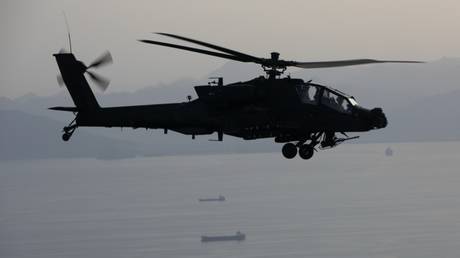
The AH-64 Apache gunship went down around 3am local time (4am Pakistan time) near the coast of Oman while conducting routine patrols of regional waters. US Central Command (Centcom) confirmed the incident but provided no immediate explanation for the cause of the crash. An investigation into the circumstances is currently underway.
President Donald Trump confirmed on Tuesday that both helicopter crew members were 'fine' following their rescue. The rescue operation was completed within approximately two hours of the crash. An unmanned surface vessel from the US Navy conducted the recovery - marking a first in American military operations history.
The Strait of Hormuz represents one of the world's most strategically important waterways. Approximately one-fifth of global oil shipments pass through this narrow strait between Iran and the Arabian Peninsula. The region has been a focal point of geopolitical tensions between the United States and Iran for years, with Iran controlling much of the waterway.
The US military maintains a continuous presence in the region to ensure safe passage for commercial vessels through these critical waters. Iran has previously threatened to disrupt shipping traffic and has at times attacked or seized merchant vessels. American patrols serve as a deterrent against such actions and provide security for international maritime commerce.
The successful drone rescue marks a significant technological advancement in military emergency operations. Unmanned systems are increasingly gaining importance across various aspects of warfare and military support functions. The use of sea drones for personnel recovery opens new possibilities for operations in dangerous or difficult-to-access areas.
Apache helicopters are among the most important attack helicopters in the US military arsenal and are deployed worldwide for various missions. The AH-64 Apache is a twin-seat attack helicopter primarily designed for ground attacks and anti-tank warfare, but also used for reconnaissance and patrol missions.
The exact circumstances of the crash remain unclear. Centcom has announced that a full investigation has been launched to determine the cause. Such investigations can take weeks or months and include technical analysis of wreckage as well as interviews with the rescued crew members.
The US military has been quietly supporting commercial ships attempting to transit the Strait of Hormuz despite ongoing Iranian threats to regional shipping. This support includes both direct naval escorts and broader security operations designed to maintain freedom of navigation through these vital waters.
The incident highlights both the continuing risks of military operations in the volatile Gulf region and the growing capabilities of unmanned systems in critical rescue missions. The successful recovery of the crew by a drone could prove groundbreaking for future military rescue operations, demonstrating how autonomous systems can effectively respond to emergency situations.
This rescue operation comes at a time when the US military is increasingly integrating unmanned systems into various operational roles. The ability to conduct personnel recovery using sea drones represents a significant capability enhancement, particularly for operations in contested or dangerous maritime environments where manned rescue assets might face additional risks.
Fast take
A US Army Apache helicopter crashed near the strategically vital Strait of Hormuz on Tuesday morning, leading to the first-ever rescue operation conducted by a US Navy sea drone.
NOFRAME signal
Stable coverage · 5 Sources · 3 Regions
What remains open
The source picture is relatively consistent. That still makes the details worth reading: small differences in wording, omissions, and source selection can reveal what each region treats as important.
Dossier compass
Which media spaces carry the story and how broad the source base is.
Source mix
Underlit angles
- Detailed geopolitical tensions between US and Iran
- Details about drone rescue
- Crew condition
Open originals
Go straight to the linked articles. NOFRAME does not replace those sources.
Why it matters
The source picture is relatively consistent. That still makes the details worth reading: small differences in wording, omissions, and source selection can reveal what each region treats as important.
Timeline
Dawn · June 9, 2026 at 12:25 PM
US helicopter crew who went down in Strait of Hormuz rescued by drone
CBS News · June 9, 2026 at 01:15 PM
First-ever U.S. sea drone rescue for Apache crew near Strait of Hormuz
BBC World · June 9, 2026 at 01:15 PM
Sea drone rescues US army helicopter crew near Strait of Hormuz
Al-Monitor · June 9, 2026 at 02:18 PM
US Navy rescues crew of Apache helicopter off coast of Oman