Chinese President Xi Jinping travelled to Washington in late September 2026 for a multi-day visit, during which he was received by US President Donald Trump at the White House. It marked Xi's first visit to the American capital in more than a decade, making the trip a notable diplomatic event regardless of its concrete outcomes. Coverage of the visit varied across international outlets in emphasis, though most reports agree on the basic sequence of events.
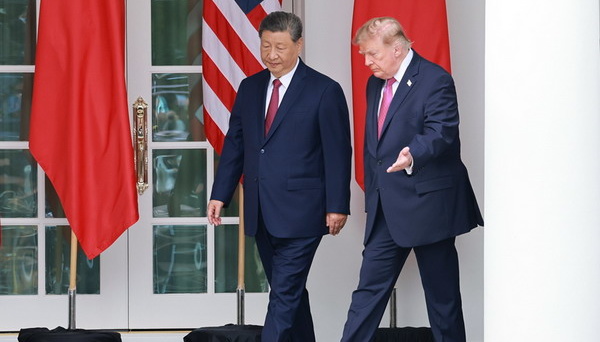
The day began with an official welcome ceremony outside the White House, featuring an honor guard. Trump and Xi then held talks in the Oval Office, followed by remarks from both leaders. Chinese state media such as CGTN documented this sequence in considerable detail, including direct quotations from Xi's remarks. According to these reports, Xi stressed that the United States and China, as major powers, needed to act responsibly together — a point also picked up by Western outlets including the BBC.
The evening centered on the visit's most prominent event: an elaborate state dinner at the White House. According to multiple consistent reports, Trump declared that he and Xi had "never gotten along better." That remark was given particular prominence in South Asian outlets such as NDTV and India Today, where it became a central focus of coverage. Western media including the BBC and NPR placed the statement within a broader context, additionally reporting on the guest list, which NPR described as heavy with technology industry figures.
A notable moment of the evening was a gift Trump presented to Xi: a specially designed statue of a bald eagle, the national symbol of the United States. According to NDTV, Trump said the statue had been created "in personal collaboration with Melania and myself." This detail also received significant attention in South Asian coverage, where it was framed more as an entertaining, symbolic gesture than as a matter of substantive policy.
Beyond the ceremonial elements, Trump and Xi also discussed Russia's war against Ukraine, the situation in the Middle East, and developments on the Korean Peninsula, according to Ukrinform. These geopolitical topics were emphasized primarily by Russian and Ukrainian outlets, while South Asian reports largely omitted them. Sputnik's account of the visit was comparatively neutral and ceremonial, offering little critical assessment of the war itself. None of the available reports specified concrete outcomes or agreements on these issues, leaving it unclear whether the discussions went beyond a general exchange of positions.
The state dinner's menu also drew coverage. According to the Straits Times, the three-course meal combined American ingredients with what the White House described as a "subtle Chinese influence," including sea bass and bak choy. Such details underscore the elaborate, ceremonial character of the evening, which several outlets described as unusually lavish.
At the same time, Asian media pointed to a striking absence: Chinese brand names were scarcely visible on the streets of Washington, and prominent Chinese business leaders were largely missing from the visit's public events. The Straits Times reported that experts cautioned against over-interpreting this absence, suggesting it could reflect logistical or protocol-related factors rather than a deliberate political signal from Chinese businesses. This point remains unresolved based on available information.
Chinese state media also raised the broader question of whether the evidently warm personal rapport between Xi and Trump could translate into a lasting improvement in US-China relations. This question was posed in Chinese coverage but not conclusively answered. Meanwhile, more contentious issues such as existing trade disputes and tariff tensions between the two countries received little attention in Chinese reporting on the visit.
Overall, the visit projected an image of considerable ceremonial warmth, while deeper political and economic questions between the two powers remained largely in the background of the publicly available coverage. Whether the visit will translate into concrete political or economic shifts beyond its symbolic gestures cannot be determined based on the information currently available.
Fast take
Chinese President Xi Jinping travelled to Washington in late September 2026 for a multi-day visit, during which he was received by US President Donald Trump at the White House.
NOFRAME signal
Stable coverage · 10 Sources · 4 Regions
What remains open
The source picture is relatively consistent. That still makes the details worth reading: small differences in wording, omissions, and source selection can reveal what each region treats as important.
Dossier compass
Which media spaces carry the story and how broad the source base is.
Source mix
Underlit angles
- Critical assessment of existing trade conflicts
- Economic tensions and tariff disputes
- Details on possible outcomes of the Ukraine discussions
Open originals
Go straight to the linked articles. NOFRAME does not replace those sources.
Why it matters
The source picture is relatively consistent. That still makes the details worth reading: small differences in wording, omissions, and source selection can reveal what each region treats as important.
Timeline
NDTV World · September 25, 2026 at 07:39 AM
"Never Gotten Along Better": Trump On US-China Ties During State Dinner
NPR World · September 25, 2026 at 08:18 AM
Trump's state dinner for Xi features sea bass and a long list of tech titans
CGTN · September 25, 2026 at 08:30 AM
Key remarks from President Xi in meeting with US President Trump
BBC World · September 25, 2026 at 08:40 AM
US and China must act as responsible powers together, Xi says as Trump toasts friendship at state dinner