Gunshots erupted at the Philippine Senate on Wednesday evening during a tense standoff involving Senator Ronald dela Rosa, a former police chief wanted by the International Criminal Court for crimes against humanity related to the country's deadly drug war.
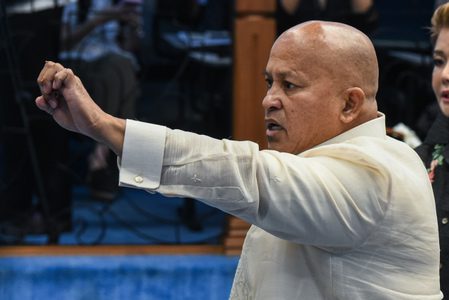
Dela Rosa, known by his nickname "Bato," had apparently sought refuge in the Senate building after the ICC issued an arrest warrant against him. The senator and former police chief faces serious charges connected to the controversial anti-drug campaign under former President Rodrigo Duterte that resulted in thousands of deaths.
According to National Bureau of Investigation Director Melvin Matibag, no arrest warrants were being enforced on Wednesday evening. The gunshots occurred during what officials described as a lockdown of the Senate building, though the exact circumstances and identity of those who fired the shots remained unclear. Officials described chaotic scenes at the parliament.
The ICC arrest warrant alleges that dela Rosa, together with co-perpetrators, "controlled a structure of power" that enabled them to "direct and control the actions" of those who carried out killings during the drug war. Specifically, he is charged with the murder of "no less than 32 persons" when he led the national police force under Duterte.
Five senators passed a resolution clarifying that the Senate "possesses no constitutional or statutory authority to provide 'protective custody' or sanctuary from lawful arrest, surrender, or judicial processes." This decision underscores the legal limitations of parliament in such cases and effectively denied dela Rosa's apparent attempt to claim sanctuary.
Dela Rosa had previously pleaded with President Ferdinand Marcos Jr. not to surrender him to The Hague. The senator had returned to parliament after a seven-month absence, apparently catching Senate leadership off guard. Senate Minority Leader Tito Sotto explained that he had not known dela Rosa would suddenly appear, noting this occurred on the same day Sotto was unseated as Senate president.
The drug war under Duterte, who governed from 2016 to 2022, claimed thousands of lives according to human rights organizations. Official figures cite over 6,000 deaths in police operations, while activists estimate significantly higher casualty numbers. As the police chief at the time, dela Rosa played a central role in implementing this policy, which targeted suspected drug users and dealers in often violent raids.
The coordination between Senate leadership and law enforcement agencies regarding arrest procedures highlights the complex legal and political situation. The Philippines finds itself caught between international obligations to uphold rule of law and domestic political loyalties to former government officials.
The events at the Senate underscore ongoing tensions between the Philippines and international justice mechanisms. While the Duterte administration had consistently disputed the ICC's legitimacy and declared the country's withdrawal from the Rome Statute, the current Marcos administration faces difficult decisions about how to handle international arrest warrants.
The drug war remains a deeply divisive issue in Philippine society. Supporters argue it was necessary to combat widespread drug-related crime, while critics condemn it as a systematic violation of human rights that disproportionately affected poor communities. The ICC investigation represents the most serious international legal challenge to those policies.
Senate Minority Leader Sotto's clarification about coordination with the NBI suggests that law enforcement agencies were prepared for dela Rosa's potential appearance, even if some senators were caught off guard. This indicates ongoing communication between different branches of government about how to handle the sensitive situation.
The incident also reflects broader questions about the Philippines' relationship with international law and institutions. The country's cooperation or resistance to ICC proceedings could have significant implications for its international standing and relationships with key allies who support international justice mechanisms.
Fast take
Gunshots erupted at the Philippine Senate on Wednesday evening during a tense standoff involving Senator Ronald dela Rosa, a former police chief wanted by the International Criminal Court for crimes against humanity related to the country's deadly drug war.
NOFRAME signal
Medium divergence · 5 Sources · 4 Regions
What remains open
Coverage is not fully split, but it is not identical either. That makes the comparison useful: the fact base shows the common core, while the perspectives show where political, regional, or institutional priorities change the emphasis.
Dossier compass
Which media spaces carry the story and how broad the source base is.
Source mix
Underlit angles
- Details about Senate resolution
- Specific ICC charges
- Coordination with law enforcement
Open originals
Go straight to the linked articles. NOFRAME does not replace those sources.
Why it matters
Coverage is not fully split, but it is not identical either. That makes the comparison useful: the fact base shows the common core, while the perspectives show where political, regional, or institutional priorities change the emphasis.
Timeline
Globe and Mail · May 13, 2026 at 04:16 PM
Gunshots fired in Philippine Senate as authorities try to arrest Duterte ally wanted by ICC
The Independent · May 13, 2026 at 05:21 PM
Gunshots fired in Philippine Senate as authorities try to arrest ex-police chief over murder charges
India Today · May 13, 2026 at 06:21 PM
Gunshots ring out at Philippine Senate as ICC-wanted dela Rosa seeks support
Daily Sabah · May 13, 2026 at 07:28 PM
Shots fired in standoff at Philippine Senate over wanted senator