US Secretary of State Marco Rubio told Congress that Iran has agreed to discuss aspects of its nuclear programme that were previously considered off-limits, potentially marking a significant shift in the stalled negotiations between Washington and Tehran.
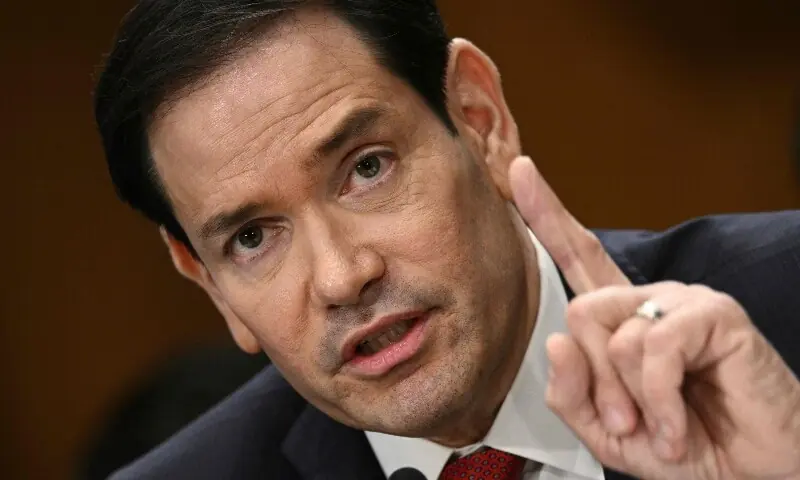
During a Senate Foreign Relations Committee hearing on Tuesday, Rubio said Iran had indicated interest in discussing parts of its nuclear programme "that just a month ago, just a year ago, they were refusing to even mention." However, he cautioned lawmakers that this development "is not a guarantee it will ultimately lead to a deal that's acceptable."
Rubio made clear that the United States would not provide sanctions relief to Iran without corresponding nuclear concessions. "Tehran must severely curtail its nuclear program before any sanctions are lifted," he told lawmakers. The Trump administration has not offered Iran sanctions relief merely for reopening the Strait of Hormuz, he emphasized.
A significant portion of Rubio's testimony concerned Iran's Supreme Leader Mojtaba Khamenei. Rubio confirmed that Khamenei is alive and "increasingly engaging at some level" in negotiations through intermediaries. The 56-year-old Khamenei succeeded his father Ali Khamenei, who was killed in the first wave of US-Israeli strikes. Mojtaba Khamenei himself was wounded in the February 28 attacks and has not been seen in public since assuming office.
The talks between the US and Iran are taking place against the backdrop of an ongoing conflict that has lasted more than three months. After the US and Israel launched strikes against Iran, the conflict has hardened into a stalemate while largely indirect talks to negotiate an interim deal have proved inconclusive. The strategically vital Strait of Hormuz remains largely shut, causing significant disruptions to international oil trade.
Rubio expressed cautious optimism about the prospects for a deal. "There is the prospect before us, which could happen today, it could happen tomorrow, it could happen next week," he told the Congressional panel. However, he stressed the complexity of the technical aspects involved. Issues regarding Iran's uranium stockpile and enrichment levels are "highly technical matters" that could take months to resolve.
Meanwhile, Iran's Mehr news agency reported that Iran is reviewing a proposed agreement with the United States to halt the war between the two countries. This came after US President Donald Trump said talks to reach a deal were continuing. Iranian sources suggested that Tehran is taking a "stern" approach in negotiations and pushing for a limited interim agreement.
The developments come at a critical juncture as the conflict continues to destabilize the Middle East. The blockade of the Strait of Hormuz has led to significant disruptions in global energy markets, while the international community has been pressing for a diplomatic solution. Israel continues its military operations despite the ongoing negotiations, adding another layer of complexity to the situation.
Rubio's testimony suggests that despite the ongoing tensions, both sides may be willing to explore compromises. The fact that Iran is now willing to discuss previously taboo aspects of its nuclear programme could represent a meaningful shift in Tehran's negotiating position. However, the path to a comprehensive agreement remains long and uncertain.
The technical nature of nuclear negotiations means that even if both sides show goodwill, resolving issues around uranium enrichment levels, stockpile sizes, and monitoring mechanisms will require extensive expert-level discussions. Rubio's emphasis on linking any sanctions relief to concrete nuclear concessions indicates that the US will maintain a firm negotiating stance.
As the situation continues to evolve, the international community watches closely for signs of progress. The outcome of these negotiations could have far-reaching implications not only for US-Iran relations but for regional stability and global energy security.
Fast take
US Secretary of State Marco Rubio told Congress that Iran has agreed to discuss aspects of its nuclear programme that were previously considered off-limits, potentially marking a significant shift in the stalled negotiations between Washington and Tehran.
NOFRAME signal
Medium divergence · 11 Sources · 3 Regions
What remains open
Coverage is not fully split, but it is not identical either. That makes the comparison useful: the fact base shows the common core, while the perspectives show where political, regional, or institutional priorities change the emphasis.
Dossier compass
Which media spaces carry the story and how broad the source base is.
Source mix
Underlit angles
- Critical details about US conditions for sanctions relief
- Technical complexity of nuclear negotiations
- Detailed background on ongoing conflict
Open originals
Go straight to the linked articles. NOFRAME does not replace those sources.
Why it matters
Coverage is not fully split, but it is not identical either. That makes the comparison useful: the fact base shows the common core, while the perspectives show where political, regional, or institutional priorities change the emphasis.
Timeline
TRT World · June 2, 2026 at 07:03 PM
Iran ready to discuss aspects of nuclear programme: Rubio
Al Jazeera · June 2, 2026 at 07:05 PM
US says Iran’s new supreme leader alive and ‘increasingly engaging’
Dawn · June 2, 2026 at 07:06 PM
Iran willing to negotiate ‘aspects’ of nuclear programme, Rubio says amid escalating scrutiny over war
India Today · June 2, 2026 at 07:45 PM
Alive and still in charge? Marco Rubio reveals new details on Mojtaba Khamenei